Why You Keep Quitting Your Goals (And Why It's Not Your Fault)
You've probably been here before. You set a goal — maybe to exercise more, read more, learn something new — and for the first week or two, you're on fire. You feel motivated, focused, like this time is going to be different. You might even download an app to track it. And then, somewhere around week three, life happens. You get busy, or tired, or just not in the mood. You miss a day. Then another. And before you know it, the goal is just… gone. Not dramatically abandoned, just quietly forgotten.
And then comes the worst part: you blame yourself. You tell yourself you don't have enough discipline. That you're not consistent enough. That other people seem to manage this, so why can't you?
I've been there more times than I'd like to admit. And I want to tell you something that took me a while to figure out: the problem isn't you. It almost never is.
The motivation cliff
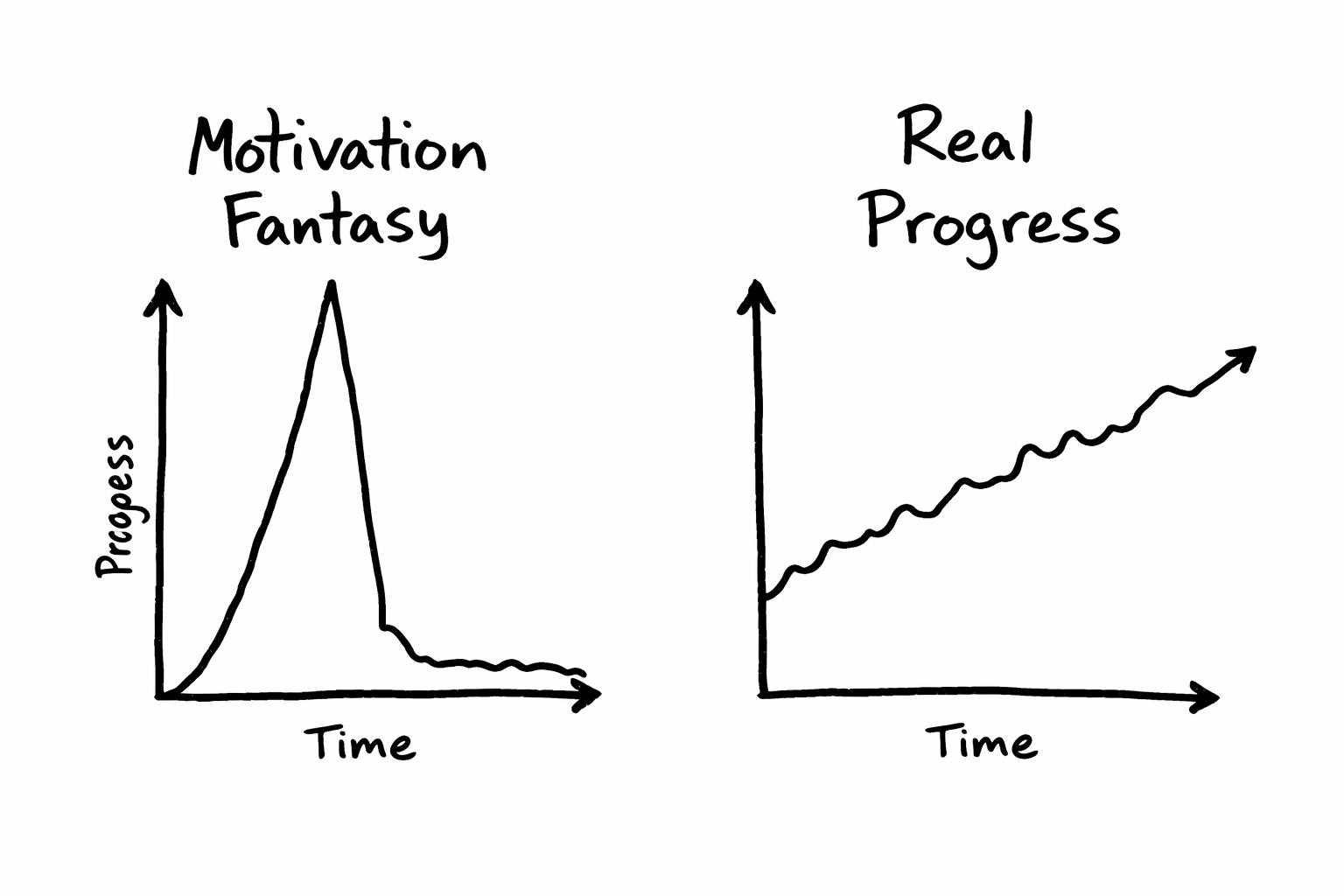
Here's something most goal-setting advice doesn't tell you: motivation is not a reliable resource. It shows up strong in the beginning, when the goal is new and exciting and your brain is flooding you with dopamine just for deciding to change, but it fades. It always fades. Not because you're weak, but because that's literally how the brain works. New things are exciting. Familiar things are not.
Researchers sometimes call this the “fresh start effect” — the burst of motivation that comes with starting something new, especially around meaningful dates like New Year's, a birthday, or a Monday morning. It's real, and it's powerful. But it's also temporary. It gets you moving, but it was never designed to keep you going.
So what happens when the motivation runs out? If the only thing holding your goal together was that initial excitement, it collapses. And you're left standing there thinking something is wrong with you, when really you just ran out of the one fuel source you were given.
Built for sprints, not marathons
The problem goes deeper than just motivation, though. Think about how most goal-setting tools are designed. They reward daily activity. They track consecutive days. They celebrate the first week, the first month, the first hundred days — all in a straight, unbroken line.
That design works if your life is a straight, unbroken line. But whose life is?
Most of us are navigating full-time jobs, families, social obligations, unexpected bad days, illness, exhaustion, and a hundred other things that don't care about our perfectly planned habits. The tools assume a level of consistency that just doesn't match how real life works. And when you inevitably can't keep up, the tool makes you feel like you failed. The streak breaks. The counter resets. The app sends a notification that feels less like encouragement and more like a disappointed parent.
It's not that these tools are badly intentioned. It's that they're designed for an ideal version of your life that doesn't actually exist. And when you measure your real, messy, human life against that ideal, of course you're going to come up short.
The gap nobody talks about
There's a gap between starting a goal and actually making it part of your life, and almost nobody talks about it honestly. The start is the exciting part — everyone loves the start. And the end, the result, that's the part you see in success stories and transformation posts. But the middle? The long, uneventful stretch where you're just… trying? That part is boring. It's uncomfortable. And it doesn't look the way you expected.
Because real progress in the middle doesn't feel like progress at all. It feels like doing a small thing on Tuesday and then nothing on Wednesday and then maybe something on Friday. It feels inconsistent. It feels like it's not working. But that is how it works. That's the actual shape of long-term change — not a straight line, but a messy, uneven one that only makes sense when you zoom out far enough.
The problem is, most tools don't let you zoom out. They show you today. They show you this week. And if this week doesn't look like last week, the system treats that as a failure.
You were set up to quit
So here's what I think actually happens when you “quit” a goal. You didn't lose interest. You didn't lack discipline. What happened is the initial motivation faded — which is normal — and the tool or system you were using couldn't carry you through the transition. It showed you a broken streak instead of how far you've come. It measured your worst week instead of your overall direction. It made the gap between where you are and where you “should” be feel like a personal failure rather than a natural part of the process.
And eventually, you just stopped opening the app. Not because you gave up on the goal, but because the tool gave up on you first.
This is the part that frustrates me the most. Because the people who quit aren't the ones who don't care. They do care — that's why they started in the first place. They're the ones who are actually trying, and the system still manages to make them feel like they're not doing enough.
What consistency actually looks like
I think we need to change what we mean when we say “consistency.” Right now, it means every day, without fail, no exceptions. But that's not consistency, that's perfection. And perfection is not a sustainable strategy for anything.
Real consistency is showing up over time. It's the person who exercises three times a week for a year beating the person who exercises every day for six weeks and then stops. It's reading a few pages when you can, not burning through a chapter every night until you're too exhausted to pick up the book. It's doing your best with what you have on any given day — and accepting that some days, your best is going to be very small.
That's not failure. That's life. And any tool worth using should understand the difference.
Building for real life
This is something I think about constantly while building The Traces. I wanted to create something that doesn't punish you for being human. No streaks to break, no scores to lose, no algorithm deciding whether your effort was “enough.” Just a quiet record of the fact that you showed up — however that looked, on whatever day it happened.
Because here's the thing: if you've ever set a goal, tried to work on it, and eventually walked away feeling like a failure, you weren't failing. You were doing exactly what most tools are designed to make you do. And you deserve better than that.
You deserve a tool that meets you where you actually are. Not where some ideal version of your life is supposed to be.

Daniel Westgaard
Indie developer from Norway and founder of Westgaard Technologies. Building The Traces — a quieter kind of goal app for people who want progress without pressure.